
Jefferson County Court Records After Arrest
An arrest in Jefferson County creates a jail record first. The Jefferson County Jail / Jefferson County Sheriff's Office Detention Center may show the arresting agency, booking date, booking number, charge text, statute reference, bond field, and a public profile while the person is listed. That jail entry is not the same thing as the court record. The court record starts when the prosecutor files charges in Jefferson County District Court, which is part of the Kansas Second Judicial District.
The local prosecutor is the Jefferson County Attorney's Office. Research for this county identifies County Attorney Joshua Ney, whose office prosecutes crimes committed within Jefferson County, Kansas, and also handles child-in-need-of-care and care-and-treatment matters. For custody status and booking details, use Jefferson County jail inmate records. For the booking-photo side of the same event, use Jefferson County jail mugshots. The court record is the filed case, not the roster card.
The official County Attorney page identifies the prosecutor's office and its local role.
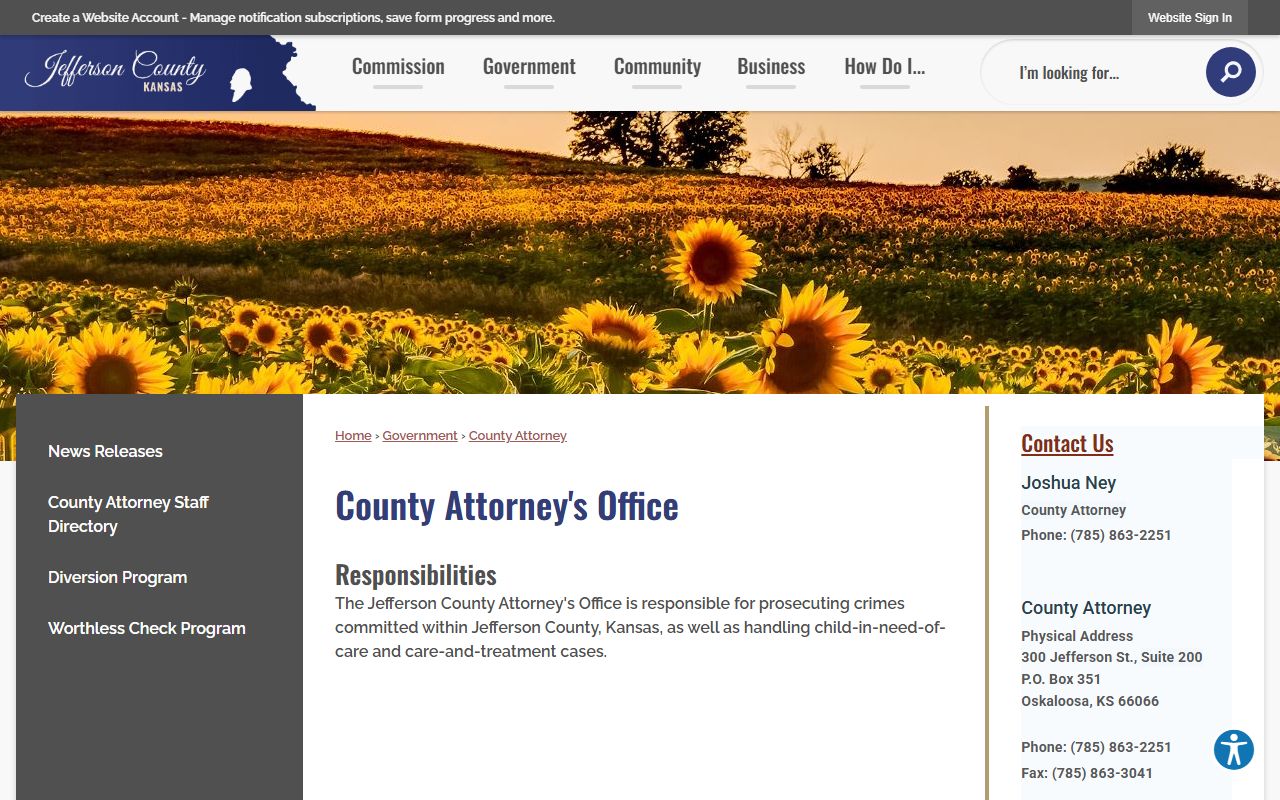
That office is the key step between a jail arrest and the criminal charges that appear in a District Court case file.
Find Jefferson County Court Arrest Records
Kansas Case Search is the statewide public portal for Kansas district court case information. The Kansas eCourt Smart Search guide says searches require a case or record number, or a name. Public search text also references party name, business name, citation, and criteria available to the user's role. Registration is required for Smart Search, and document requests must be made in writing through the court process when the online entry is not enough.
- Copy the defendant name, booking date, arresting agency, and charge text from the Jefferson County jail profile.
- Search Kansas Case Search by party name or case number, using Jefferson County details to narrow common names.
- Open the matching District Court case and compare the filed charge list with the jail booking charge.
- Check each charge for status, disposition, bond notes, hearings, and later amendments.
- If the case is not clear online, contact Jefferson County District Court for written record-request instructions.
The Jefferson County District Court contact page lists Clerk of the District Court Katie Chaney at 300 Jefferson St., P.O. Box 327, Oskaloosa, KS 66066. The court phone is 785-863-2461, fax is 785-863-2369, and office hours are Monday-Friday, 8:00 a.m.-4:00 p.m., excluding legal holidays. District court records are handled by the court, not by the county open-records officer.
The Kansas Case Search portal is the first online stop for filed Jefferson County court records after a jail arrest.
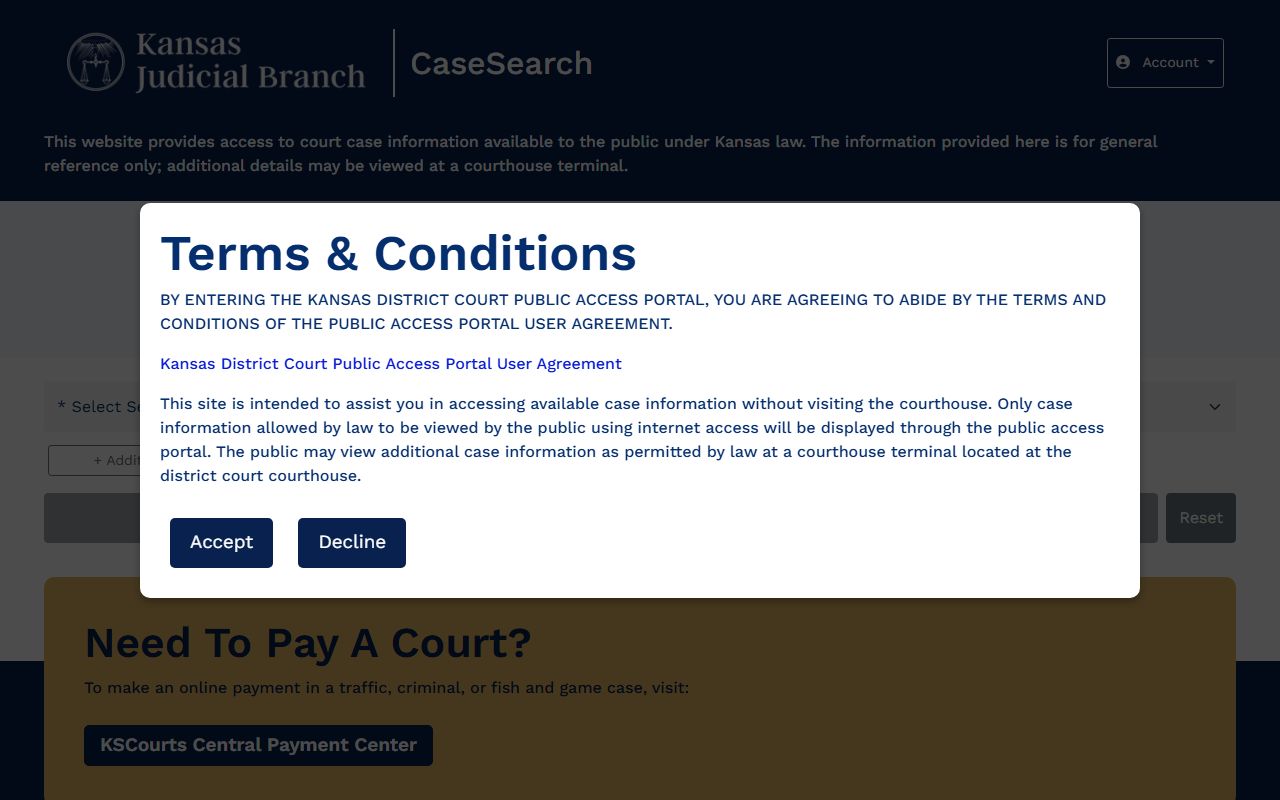
Use the case-search result as a court docket pointer, then request documents in writing if a complaint, order, or journal entry is needed.
Jefferson County Court Search Fields
The court search fields differ from the jail roster. The jail roster is built around current custody and recent release data. Kansas Case Search is built around court cases and parties. For a person arrested in Jefferson County, a name search is often the practical first pass, but the case number is stronger once it is known.
| Field Label | Type | Required | Options / Format Notes |
|---|---|---|---|
| Case number / Record number | Text | Required if not using name | The Smart Search guide says a record or case number can be used. |
| Party name | Text | Required if not using case number | Use the defendant name from the jail booking profile. |
| Business name | Text | Optional or role-dependent | Listed in Kansas Case Search result text. |
| Citation | Text | Optional or role-dependent | Useful when a citation number exists. |
| Other role criteria | Varies | Role-dependent | Available search options can depend on registration and user role. |
Jefferson County Charging Records
After a Jefferson County jail arrest, the County Attorney decides what, if anything, to file in court. The jail roster may show an arrest or booking charge. The filed court charge may match it, narrow it, add counts, or use a different legal theory. The charging document is the bridge between the booking and the District Court case.
| Document | Who Files It | What It Does | Why It Matters |
|---|---|---|---|
| Complaint | Prosecutor or law-enforcement based filing | Starts a criminal case by alleging facts and offenses. | Often the first filed charge record after arrest. |
| Information | Prosecutor | States the formal charges the prosecutor pursues. | May replace or refine the charge path after review. |
| Indictment | Grand jury | Charges based on grand-jury action. | Less routine, but still a charging document that opens a case. |
Do not treat the charge line on the jail roster as the final case result. A roster charge can be useful for searching, but the complaint, information, indictment, journal entries, and disposition control the court record.
Jefferson County Charge Status
Charges can change after the first court appearance. The research file notes several plain-English terms: pending means unresolved, amended means changed, dismissed means the court or prosecutor ended that count, disposition means the case outcome, conviction means guilt was adjudicated, and diversion means prosecution may be deferred under conditions. These terms matter when comparing a jail arrest record with the court record that followed.
| Status | What It Means | Reader Caution |
|---|---|---|
| Pending | The charge is still open. | Hearing dates and bond terms may still change. |
| Amended or reduced | The filed charge changed after review or negotiation. | The jail roster may still reflect older booking text. |
| Dismissed | The count ended without a conviction on that count. | Other counts in the same case may remain active. |
| Diversion | Prosecution may be deferred under stated conditions. | Check the case terms before treating it as closed. |
| Conviction | Guilt was adjudicated by plea or trial. | A conviction is different from a mere charge. |
Bond After Jefferson County Arrest
The Jefferson County roster publishes a bond field on list cards and public profiles, but the profile warning says charges and bail may change after court appearances and may not be current. Bond companies and people posting bail are told to contact Detention Center staff at 785-863-2765 for the correct bail amount, charges, and case numbers. That warning should control any bond decision.
A local sheriff scam alert adds a practical rule: anyone bonding an inmate out must physically come to the Sheriff's Office, fill out the paperwork, and pay the bond amount at that time. If someone calls demanding bond payment by phone, the sheriff's alert says to hang up and notify the Sheriff's Office. Holds can also block release. A detainer is another agency's request that the jail keep the person. A no-bond hold, probation hold, warrant hold, ICE detainer, or KDOC transport issue can keep a person in custody even when a dollar field appears.
| Bond Type | How It Works | Jefferson County Check |
|---|---|---|
| Cash bond | Full amount paid as required by the court or jail. | Call detention staff before bringing payment. |
| Surety bond | A licensed bonding company posts under its terms. | Bond companies should verify amount, charges, and case number. |
| PR release | Release on written promise and conditions. | The court controls the conditions. |
| No-bond or hold | Release is blocked or not yet set. | A $0 field should not be interpreted without calling. |
Jefferson County Warrant Arrest Records
A warrant can be the reason a Jefferson County jail arrest happens. The Sheriff's Office publishes an active warrant list with search by name, name/date sorting, newest-to-oldest and oldest-to-newest sorting, and pagination. Visible warrant entries include name, age, warrant date, and charge text such as Failure to Appear, FTA, AGG FTA, Revoke Bond, or Indirect Contempt. The live count changed during research, so rely on the current page rather than a copied number.
A failure-to-appear warrant often leads to booking at the Jefferson County Jail. The court case may then show a missed hearing, bench warrant, bond revocation, or new warrant-related charge. Search warrants are different. They are not the same as arrest warrants and usually do not appear as jail roster records. Confirm warrant status with the Sheriff's Office at 785-863-2765 before taking action because a warrant can be served, recalled, or changed.
The Jefferson County warrant page shows the search and sort tools used before a warrant arrest reaches the court record.
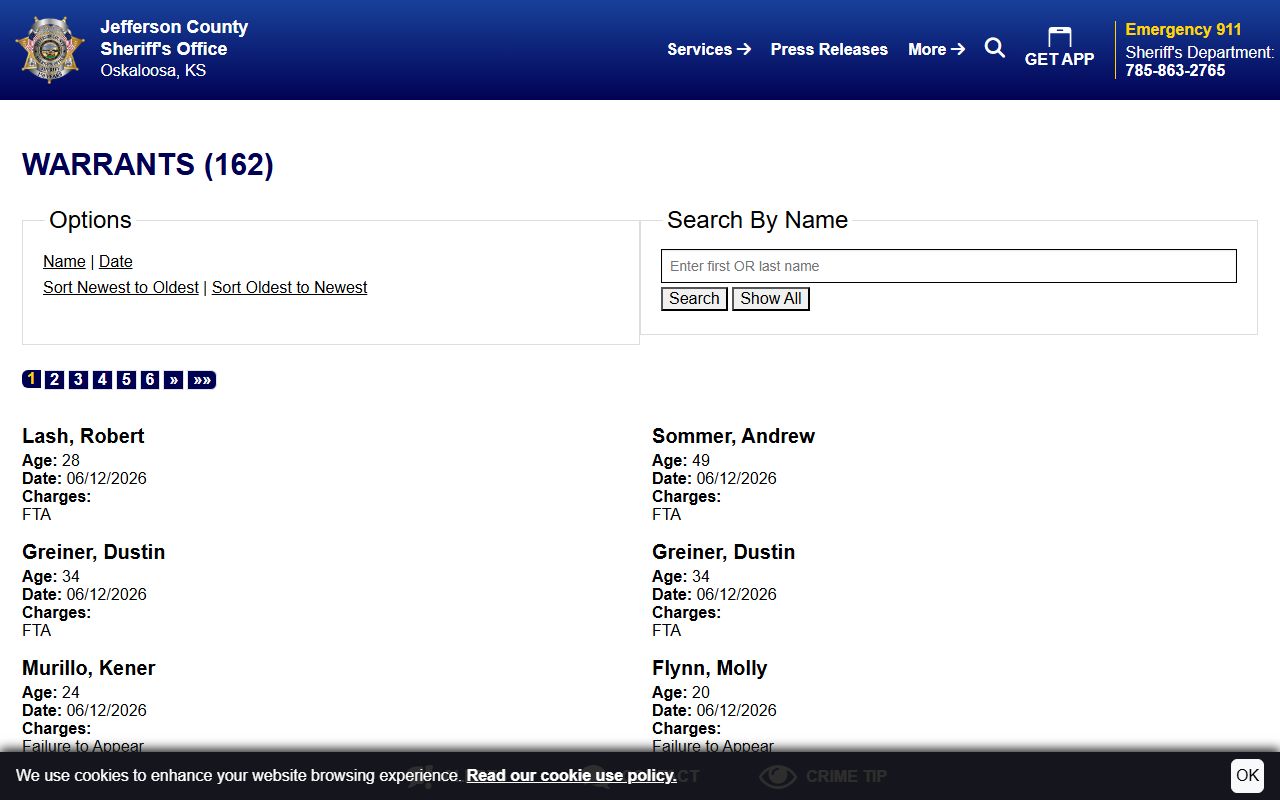
For a warrant tied to a filed District Court case, use Kansas Case Search or contact the Clerk of the District Court.
Jefferson County Charges vs Convictions
A charge is an accusation. A conviction is a court result. That distinction is central to court records after a jail arrest because a person can be booked, charged, and later have a charge amended or dismissed. Kansas Case Search and written court records should be read for the current status and final disposition, not just the first line that appeared after booking.
| Point | Charge | Conviction |
|---|---|---|
| Stage | Filed accusation after arrest or review. | Final guilt finding by plea or trial. |
| Proof level | Based on charging decision and probable cause. | Requires adjudication under the criminal standard. |
| Record use | Shows what was alleged and tracked. | Shows the resolved offense if guilt was found. |
| Change risk | Can be amended, reduced, added, or dismissed. | Can still be affected by appeal or expungement. |
Sealed and Expunged Records
Kansas access law starts from openness. K.S.A. 45-216 states the public policy that records are open unless the law provides otherwise. KORA exemptions can still limit criminal-investigation, juvenile, sealed, expunged, or otherwise protected material. For arrest clearing, K.S.A. 22-2410 allows a person arrested in Kansas to petition district court for expungement of an arrest record. K.S.A. 21-6614 covers expungement of certain convictions, arrest records, and diversion agreements.
| Point | Sealed | Expunged |
|---|---|---|
| Public view | Public access is restricted by court rule or order. | Public access is limited through the statutory expungement process. |
| Typical trigger | Confidential record type, protected party, or court order. | Eligible arrest, conviction, or diversion record after petition. |
| Where to ask | The court that controls the record. | District court under the Kansas expungement statutes. |
| Practical result | Searchers may see less or no public detail. | The public court or arrest record may no longer appear in the same way. |
KBI History and Record Limits
A court docket is not a full criminal-history report. The Kansas Criminal History Record Search portal is the KBI name-based record-check path. The research file lists the Kansas Criminal History Record Search portal and KBI instructions, with a $30 Kansas.gov purchase price for a name-based check. The portal also has a daily maintenance window of midnight to 4:00 a.m. Central Time.
KBI history checks answer a different question than Kansas Case Search. Case Search helps locate filed district court case information. A KBI check is statewide criminal-history access, and KASPER is for Kansas Department of Corrections custody or supervision data. KASPER itself warns that its offense history is not a complete criminal history and should not replace a KBI criminal-history search.
Important: Public jail, court, warrant, and KBI records should not be used for employment, housing, credit, insurance, or tenant-screening decisions unless the user has a lawful FCRA-compliant source and purpose.
Restricted Jefferson County Court Records
Some Jefferson County court records after an arrest may be unavailable or incomplete in public search. Kansas open-records law allows inspection unless a record is closed by specific law, but KORA exemptions and court access rules protect some criminal-investigation records, juvenile records, sealed filings, expunged records, and personal identifiers. The Kansas Judicial Branch request-court-records page says some case information is online, while document requests must be made in writing.
For sheriff records, Jefferson County's FAQ gives in-person, mail, and email request paths and says reports are not faxed. For District Court records, contact the court instead. For County Attorney prosecution records, do not assume the office will release work product or active-case material. Use the public docket first, then request specific filed documents from the court that maintains the case file.
Public Record Search
Sponsored Results